Why AI Headshots Look Plastic - and Why Real Is the New Expensive
I keep seeing the same faces in my feed.
No pores. A chin that is almost yours, but not quite. Eyes that are neat and say nothing. An AI headshot costs about $5-30: upload a selfie, get yourself back - only plastic.
I am a headshot photographer in Halifax, so yes, I have a side in this. But I am not writing this because AI is coming for my job. I am writing it because I watch what these photos do to the people who use them, and the problem is not picture quality. The problem is trust.
What "plastic" actually means
When people say an AI headshot looks plastic, they cannot explain why. Here is what I see, over and over again:
- Skin with no texture at all - no pores, no small lines, nothing real skin has.
- A face that is almost the person, but slightly off - the chin, the jaw, the smile.
- Perfect, even, characterless light that exists in no real room.
- Eyes that are sharp and empty at the same time.
- The same polished look as everybody else who used the same service.
One sign would be a detail. All of them together are a feeling: this is not a person, this is a product render.
The real problem: what a client reads from your photo
Here is the thought a client has, even if they never say it out loud: if even his photo is made in ChatGPT, maybe my job gets the same treatment - something generated that only looks like work.
Photographer Chris Gillett put it harder than I would: every AI headshot holds two lies. It pretends to be a photographer. And it pretends to be you.
Your headshot is the first thing people taste of your work. Plastic, or a person - that first taste sets the price of everything after it.
The uncomfortable research
Now the honest part, because the numbers are not simple.
In a Ringover survey of 1,087 recruiters, blind tests went well for AI: recruiters chose the AI-generated headshot over the real one 76.5% of the time. People are bad at spotting AI, too - recruiters identified it correctly only 39.5% of the time.
But then the story turns. When recruiters knew a headshot was AI-generated, 66% said it would put them off the candidate. And 88% said using an AI headshot should be disclosed.
And what gave the AI images away? Glitches first - and second, at 43.6%, was "too flawless". Read that again. The thing people pay AI to do - erase every pore and line - is one of the main things that exposes it.
In Canada the background is even less forgiving. Research Co. found in September 2026 that 80% of Canadians say it is getting harder to trust images online, because they might be AI-generated. Your clients in Halifax are looking at your photo with that suspicion already switched on.
Can anyone actually check?
More than they could a year ago. Microsoft Research tested over 12,500 people on telling real photos from AI ones; they were right only 62% of the time - barely better than guessing. So no, most people will not catch you by eye.
But checking is becoming a tool, not a talent. In October 2026 Google opened its SynthID Detector to everyone - it finds the invisible watermarks of participating AI tools. It does not catch everything, and "no watermark found" does not prove a photo is real. The direction is still clear: generated faces are getting easier to question, and platforms are moving the same way - Instagram now limits the reach of profiles built on an undisclosed AI-generated person.
LinkedIn's own rule is the simplest version of all: your profile photo must reflect your likeness. Enhancing is fine. Replacing you is the problem.
Where AI is welcome in my own studio
I use AI myself - for routine work, sorting, drafts, and planning. The less of it there is in the final result, the better, but as a tool inside the process it is genuinely useful.
That is my line, and I think it is a fair one: AI in the process is fine. AI instead of the person is not. The camera session is the part that cannot be generated, because the valuable thing in a headshot is not pixels - it is a real expression, caught in a real moment, directed by a person who does this every week.
What a real headshot gives you that a generator cannot
- An expression that is actually yours, worked out with direction, not averaged from selfies.
- Skin that looks like skin - retouched with restraint, not erased.
- Crops that work everywhere: wide for your website, medium for LinkedIn, tight for your personal brand.
- Consistency for a whole team, so your company page looks like one company.
- A photo you can stand behind in the room, because the person in it is the person who walks in.
And the money is not even the argument
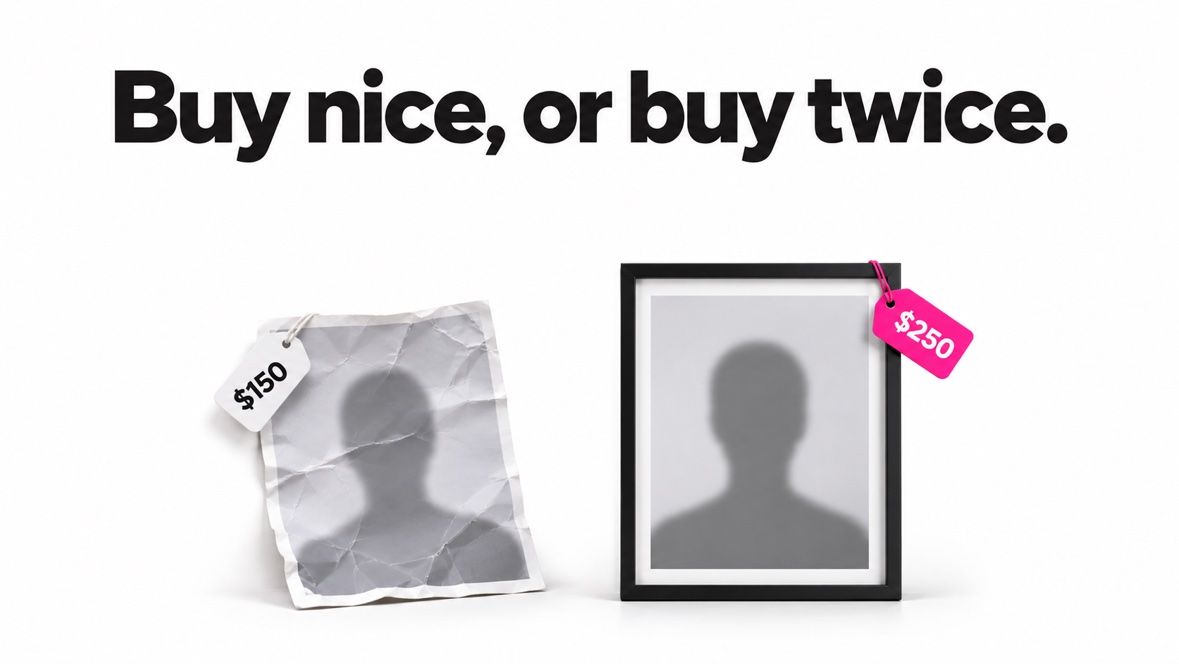
People assume the gap is huge. It usually is not. A pack of AI images costs up to about $30. A real headshot session with me in Dartmouth starts at $99.
It is the same pattern as food. Ultra-processed food is still food, and it is cheaper. But a fresh steak costs more for a reason you can taste. The more generated material there is around us, the more the real thing stands out - and the more it is worth.
Questions clients ask me about AI headshots
Are AI headshots banned on LinkedIn?
No. LinkedIn allows AI tools, but your photo has to reflect your real likeness. A generated face that only roughly resembles you is where the trouble starts - with the platform, and with anyone who later meets you in person.
If recruiters cannot spot AI, why does it matter?
Because the risk is not being spotted by eye. The risk is being found out - by a watermark check, a reverse search, or simply by looking different when you walk into the interview. The Ringover numbers say the discovery is what costs you, not the image itself.
I already bought an AI pack. Is it useless?
Not useless - treat it as a placeholder. For a low-stakes avatar it may be fine. For client-facing roles, leadership pages, and anywhere trust is the product, replace it with a real photo as soon as you can.
Real is the new expensive
AI headshots are fast, cheap, and better than they were last year. They will keep improving. None of that changes what your photo is for: it exists so a stranger decides, in about two seconds, that you are real and worth their time.
If you want a headshot that passes that test - in Halifax, Dartmouth, or on location anywhere in HRM - that is exactly what I shoot.
Planning your session? These two guides will help: What to Wear for a LinkedIn Headshot in Halifax and LinkedIn Headshots vs. Corporate Headshots.
share this
Related Articles